The Glasgow HAMILTONS
- a personal memoir
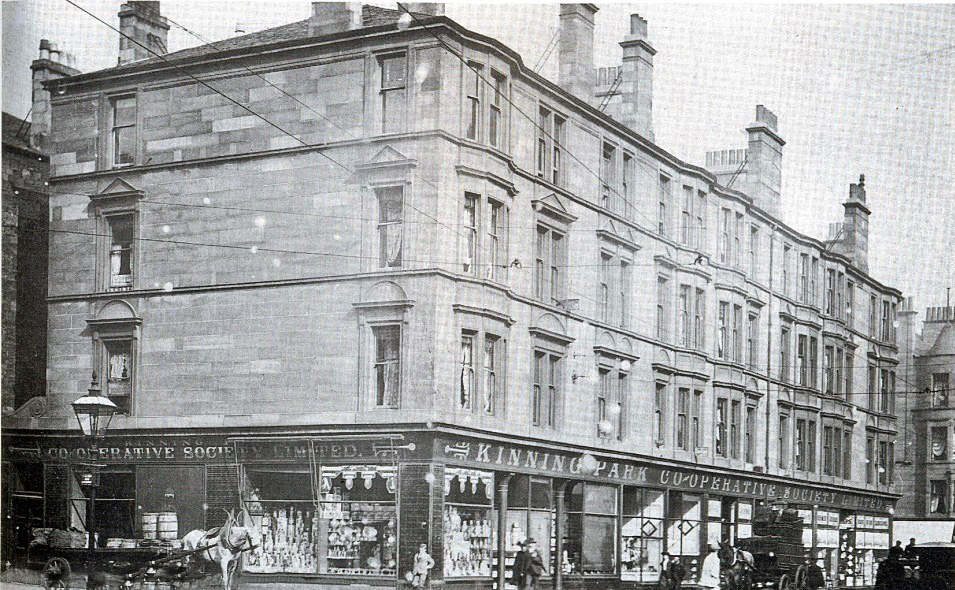
Jane McAinsh Stewart met William Francis Hamilton when she was a cash girl at a
Coop grocery shop on the corner of Preston Street
and Cathcart Road,
where he was an assistant. The assistants used to pass her the customers' cash in a tube that was hauled up on a
string to a little office above the counter. The family's Dividend Number was 28: they were able to pay the rent
(£11) with the Divvy.
Their marriage on 9 June 1914 was held in a pub - the Wheatsheaf Rooms at Paisley Road Toll.
There were 50 guests, including many children.
By the following year, William had become manager of the shop.
Then, despite having poor eyesight, he was Attested on 9 December 1915 and Mobilized on 26 April 1917. He managed to get back to Glasgow for his son Kenneth’s christening in early 1918. He served in France from 1 May 1918 to 26 October 1918 as a Rifleman and Machine Gunner in the 11th Battalion of the Royal Scots Fusiliers. He was shot in both thighs on 24 October 1918 and sent to Huddersfield War Hospital on 25 October, remaining there until 17 January 1919. He was discharged on 15 February 1919. His wounds gave him a permanent limp.
On his return to Glasgow, he resumed work with the Coop. His bosses must have thought a lot of him for they moved him to a brand new shop in King's Park.
A few years later, a Mr Stevenson (who occupied the top floor flat at No 37 McCulloch St) was instrumental in helping William join the Masons.
He soon became the Right Worshipful Master of a local Lodge - it is not known which one.
He was not particularly ambitious: his brother Arthur once told him, "Willie, you should set up on your own."
But he was too scared to take the risk.
Despite having good connections, he was turned down for promotion to area manager in his late 30's, possibly because he was not a Union man. He was bitter and became withdrawn and unsociable, retreating to his plot (allotment) whenever he could. Before that he had been quite a jolly man.
He had no conversation though, and when courting Jane, used to talk about the price of tea going up on the way to the venue and the price of tea going down on the way back.
According to Elizabeth, his daughter, he was good at English and wrote poetry.
He used to play bowls on his half day off, Tuesdays, and tended his plot at other times.
This writer, his grandson, remembers him as a rather taciturn man with a hacking cough, who didn’t have much to do with his grandchildren.
The cough was caused by bronchitis, due to his smoking.
He died at the age of 74 on 10 March 1960.
Jane, his wife, was a shy, reserved woman - she admitted that she had no confidence socially.
Her daughter Elizabeth, aged 12, once had to go in her place to a Lodge dinner and hand out the prizes because she was too frightened to do it herself.
She got on well with her sister (Elizabeth) because they were similar personalities.
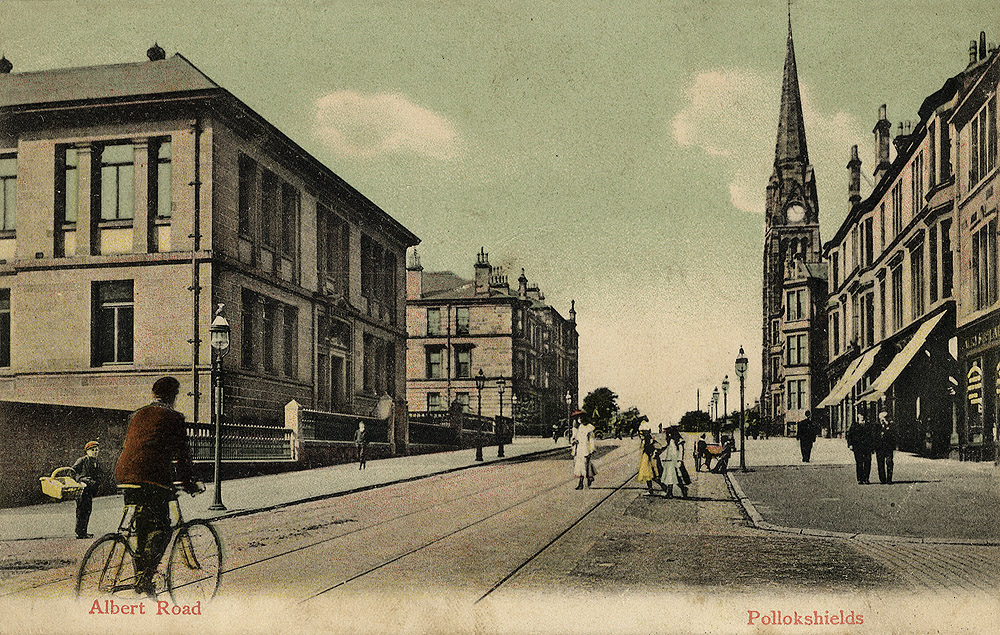
She felt Govanhill was beneath her, so paid 5 shillings a quarter for her daughter to go to a school (Albert Road Academy) one mile away in Pollokshields where she mixed with kids who lived in nice houses rather than poky little flats. They included the daughters of a minister, a banker, a bacon wholesaler and Jewish businessmen. She would walk her daughter to school while pushing Kenneth in his pram.
The family went to Strathbungo Church in Shawlands. William wanted Sundays for a lie-in, so they only went there for Communion once a month or so.
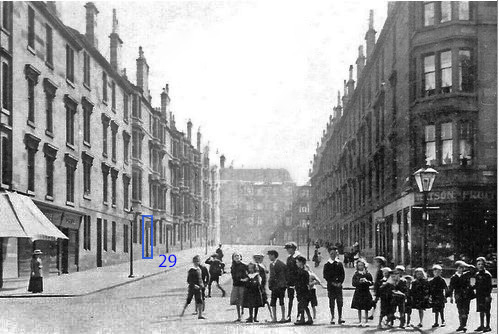
Elizabeth Stewart Hamilton was born at 29 Carfin St Govanhill on 26 July 1915 at 7:30 am.
William Kenneth Hamilton was born on 17 September 1917. He was named after his uncle, who had died at
Romeries in 1918.
Jean Stewart Hamilton was born on 2 May 1920 at 29 Carfin St. According to her sister, she had red hair and blue eyes.
She survived for 7 weeks, dying on 25 June. Her sister Betty had chicken pox at the time and for most of her life believed that
she had passed it on to her sister. In fact, Jean died of a congenital heart defect.
Douglas Hamilton was born on 31 January 1922.
Like his older brother and sister, he went to Albert Road Academy and the adjacent senior school.
In 1936 his parents found him a job in the Coop's drapery warehouse; he later became a drapery rep, travelling throughout southern Scotland.
During the Second World War he was a Private in the REME, in a Signals Regiment, where he learned about radio electronics.
This gave him a lifelong interest in things technical - he was especially fascinated with cine cameras. And with cars: he had a Baby Austin A30, then
an Austin A35 and an Austin 1100 (which he sold to his brother-in-law), followed by a series of Japanese cars, ending with a Nissan that his sister bought for him.
The couple lived on the first or second floor of
29 Carfin Street, Govanhill.
Only the north-west side exists today (2019), the entire east side between Cathcart Road and
Batson Street having been demolished to make way for a gym.
The flat was on the north side of the street and, according to Elizabeth Hamilton,
was a Two-Room-and-Kitchen, having a parlour, a kitchen and a bedroom, with a toilet on the stair.
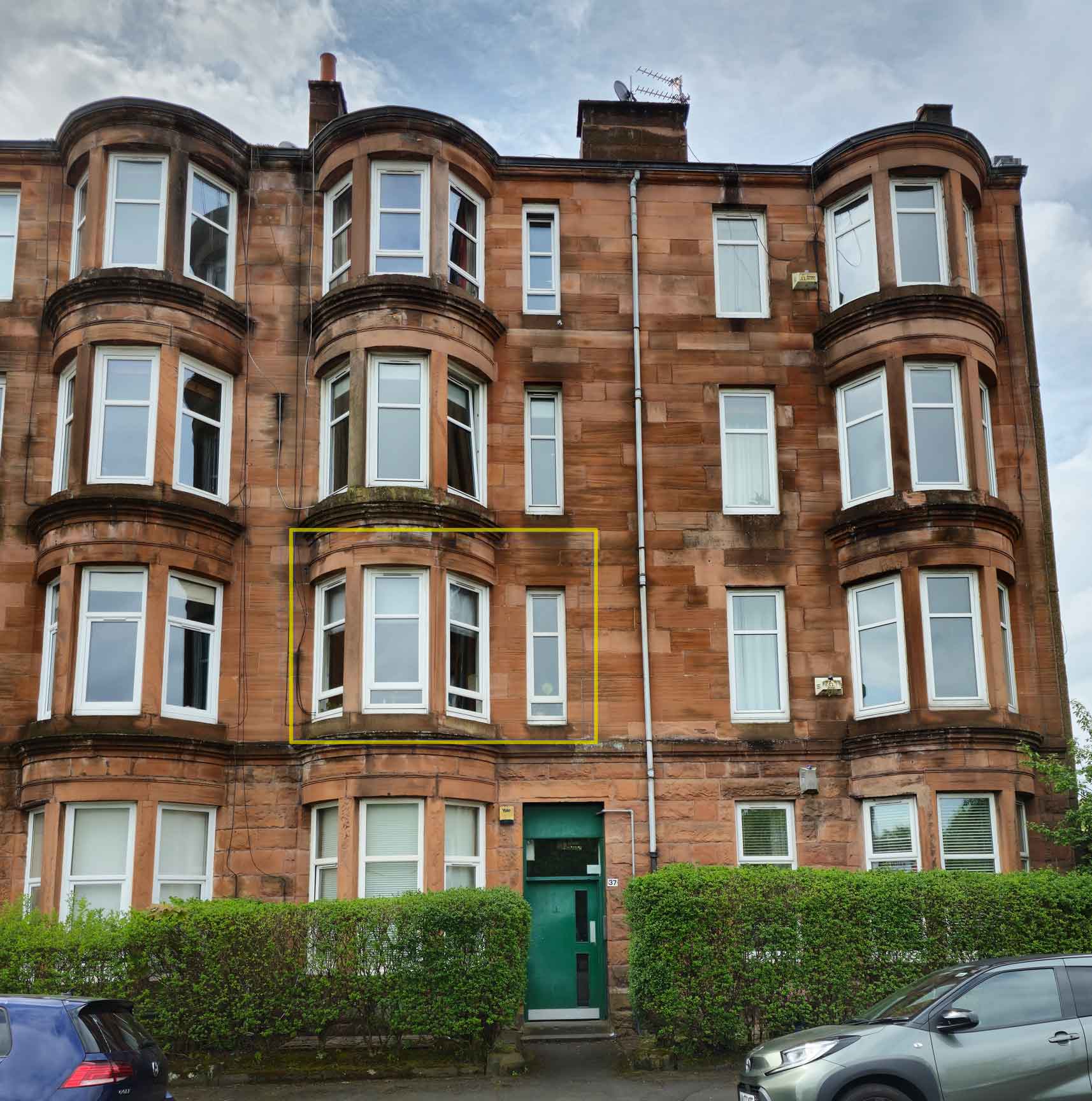
By the early 1920s the family had moved to upmarket Pollokshields, to a 1st floor left flat at 1-2
37 McCulloch Street,
at a rent of £22.
According to Elizabeth, the flat was a Two-Room-and-Kitchen – it had a parlour, a bedroom and a dining kitchen.
However, this may not have been accurate:
in this block, 25 to 37 McCulloch St, flats on the east (left) side of the main entrance are designated ‘2’.
From the front, these flats have one bay window and a small bathroom window, whereas flats designated ‘1’,
to the west, have a bay window and a bedroom window, with the bathroom window at the back.
If the family’s flat really was on the left side, it would have been a Room-and-Kitchen, with a parlour
and a dining kitchen, bed recesses in both rooms and a bathroom.
Elizabeth did report that in those days all 3 children had to share a bed.
The flat was just round the corner from the Stewart family flat at 181 St Andrews Road, which was occupied
by Elizabeth, Jane's sister. For Jane it must have felt like coming home.
Later, she put the family’s name down for one of the new Corporation houses, but did not want Mosside,
where the houses were being built. Instead, she wanted an older Corporation tenement in Victoria Road,
but they were very popular and none came up where she wanted one - near the shops.
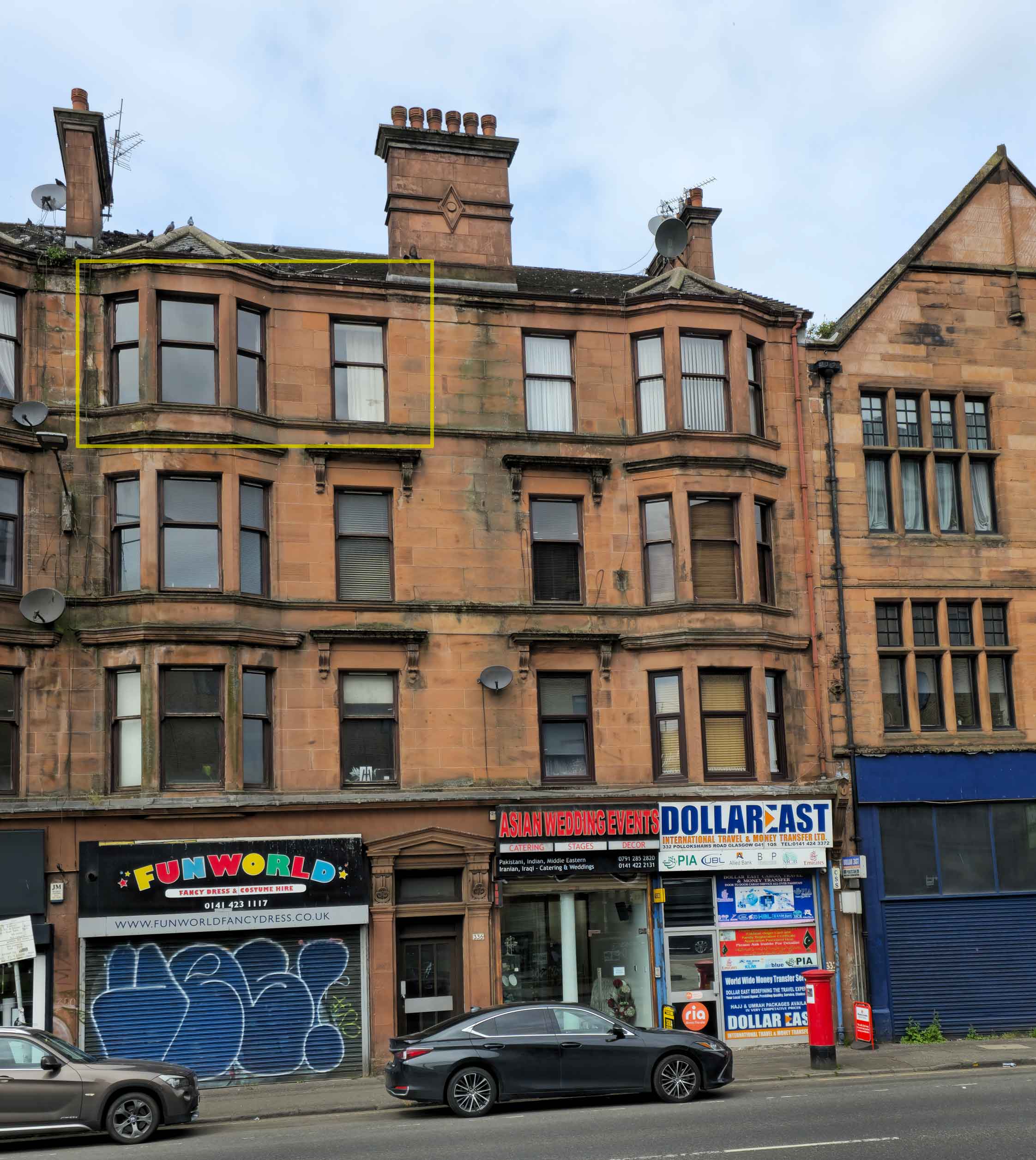
So, in 1936, the Hamiltons moved to a privately-owned top floor flat at 3-1
336 Pollokshaws Road.
It had a fine view over the St Andrews Cross junction of Pollokshaws Road and Victoria Road near Eglinton Toll.
Jane loved sitting in the bow window looking down at the bustling life below – at people waiting for trams or
crossing to the Plaza Ballroom or sitting in the little park between the two roads. In the distance the furnaces
of Dixon’s Blazes spewed flame.
The flat was a Two-Room-and-Kitchen with a bath in a long, narrow bathroom, but the shared WC was on the landing below.
The kitchen/living room had a box bed recess where William and Jane slept. Guests had the use of a sofa bed. There was a black range with a back boiler
to heat the water. The narrow scullery had been converted to a cramped kitchen. The large lounge also contained a
box bed recess, where the boys slept. Elizabeth, as a young woman, got exclusive use of the bedroom.
The flat had an annual rental of £32 10s.
Jane had an arthritic knee, which was always thickly bandaged and caused her to limp. I was told that it was the result of a slip when she came to visit me in hospital on the day of my birth. The story did not, fortunately, give me a guilty conscience.
She died of a heart attack at 76 on 9 September 1963. Her son Douglas had to break down the door when there was no answer.
She was known as Betty but used to make up more exotic names, including Lisa, Lissa and Ailsa.
Her mother used to say that with her black hair she looked Jewish and wondered if there was Jewish blood on her father's side.
She sometimes went off on her own and got lost. Once, when picked up by concerned strangers, she gave her name as Peggy Apperton (=Betty Hamilton).
She was devoted to her two little brothers - they used to sit next to her at table. Douglas would hold her hand.
She got 2d pocket money on Saturdays and 1d on Tuesdays because those were her father's days off. You could, she said, buy a poke of sweets for a farthing from Wiseman's shop.
In 1921, at the age of 5, she started at
Albert Road Public School in Pollokshields
(it was later named Albert Road Academy - ARA).
It was a mile and her mother would walk her there while pushing her younger brother Kenneth in his pram.
Her mother thought it was in a better area than Govanhill. It was a fee-paying school (5 shillings a quarter) and, for her mother, it meant her daughter could rub shoulders with children from wealthy families who lived in some of the finer houses in Pollokshields.
Elizabeth saw that the spacious homes her friends occupied were a cut above her own cramped 'Room and Kitchen' a place she was too embarrassed to invite friends back to.
She wanted better and set out to get it, so ending up 35 years later in a 5 bedroomed house in Yorkshire.
When the 1921 Education Act abolished school fees, the wealthy children left to go to private schools such as Glasgow High, Glasgow Girls High and Glasgow Academy.
By 1923, the Hamiltons had moved to a slightly larger flat at 37 McCulloch Street, in Pollokshields.
In 1926 ARA combined with Pollokshields Public School and became Pollokshields Secondary School. Elizabeth stayed there until she was 17.
She was usually near the top of the class and in her 3rd year at senior school was elected class Captain.
Art was a different matter, though: the art teacher put her alone at the front of the class because she was no good at it.
For maths her aunt advertised and paid for a young tutor to help get her through the exams, which she passed.
She was not sporty – she hated gym, which involved sitting on top of the wall bars or balancing along the beam. She was nicknamed Froggie by a friend.
On Saturdays, when everyone had to go and play hockey, she made the tea.
Auntie Lizzie (Attie) took Betty, the daughter she never had, under her wing.
She had seen that her niece was good at school, so encouraged her to stay on beyond the usual leaving age of 14 or 15.
Her father, though, was not keen: "You'll soon get married," he said, "What's the point?"
One of her classmates, an only child called Myra, whose father was a teacher, wanted to be a doctor:
she eventually went to Glasgow University Medical School.
Betty got better Highers than Myra and could also have gone to University – her aunt offered to pay,
but she felt it was not right that she should get such special treatment over her brothers
(even though they were not academically bright enough and did not want to go to University).
Holidays, when she was young, were taken in Millport, where they rented a ground floor flat in Glasgow St for a month. Her father would come down for his 2 weeks holiday during the Glasgow Fair in July.
She claimed that her father took her for a walk round the island when she was only 2½ years old.
She also had a fortnight with her friend Mattie Campbell ‘doon the watter’ in Dunoon or elsewhere on the Firth of Clyde. Mattie was an only child; her step-sisters were too old to play with.
Betty was criticised by Mrs Campbell for turning up her nose at fish (it was too bony). Mrs C thought she was spoilt. But Jane Hamilton never forced her children to eat things they did not like.
In Elizabeth’s teens, several holidays were taken on the Isle of Man.
In 1931 she was employed as an enumerator for the Census of that year and visited a number of two-room-and-kitchen flats and also some Single Ends, saying the conditions she found there were terrible.
After leaving school in 1932, she got occasional temporary work in the Coop's drapery department when they were short-staffed.
Then Mr Stevenson, her father’s Mason friend, got her into the Central Agency of J & P Coats, the thread manufacturer. Her pay was 15/- per week.
She worked in the huge Dissections department in Bothwell Street, analysing invoices from a variety of countries and assigning them to the company’s departments. The Agency said they wanted typists, so she did two nights a week learning touch typing and shorthand. She worked in the typing pool, and was also assigned to other departments for short periods.
During the War, the Agency paid her salary, sending it to her mother, who banked it.
After the War, she became Secretary to Ian Coats in the J&P Coats part of the building in Glasgow. She had a small office attached to his but no telephone. Coats, she said, was a very nice man who behaved just like one of the staff.
She used to go walking and hostelling in the Kilpatrick Hills and maybe the Crianlarich area, going by train with girlfriends from the Agency.
One was called Vora, from Turriff in Aberdeenshire. She invited Betty to holiday with her in Banchory, staying at a cousin's whose parents lived above their shoe shop on the main street.
She also visited Spinningdale with a friend from Tain. The two aunts they stayed with were serious Presbyterians and insisted that nobody, including guests, did anything resembling work on Sundays. This included hobbies. Reading the bible was fine, though. But they did run a General Store that sold alcohol.
Her Aunt Lizzie, who had become a glove buyer for the Coop, used to take her to visit her clients in their big houses in south Glasgow. She passed her off as her own daughter. The clients often gave her expensive gifts that she gave to her niece – porcelain figurines and vases and bone china plates were popular.
Aunt Attie was an unusual woman for the period. She believed that women could be independent and have their own careers.
While living at 37 McCulloch Street, Betty often stayed with her in her flat just round the corner at 181 St Andrews Road – it was a relief for her not to have to sleep with her brothers in the cramped McCulloch Street flat.
But she complained to her mother that the flat was cold. And so Attie used to put her to bed wrapped in brown paper!
Aunt Attie was supposed to have a black cat called James, which she got to protect her from the risk of burglars (it was a ground floor flat).
There was no obvious reason, said Betty, why 181 St Andrews Road was considered posh – after all, there was a railway and a gas works just across the street. But it did have a bathroom, so was quite desirable.
While on a golfing holiday with a Central Agency friend in Whiting Bay, Arran, she received a set of clubs for her 21st birthday. Her friend was bitten by a cleg and had to return to Glasgow. Betty fell in with Eric Smith, a 29 year old banker from Edinburgh. He had been educated in an expensive private school and Betty’s mother thought this was tiptop. Eric visited her in Glasgow several times. But she thought his false teeth were a bad point and Edinburgh too inconvenient. The relationship foundered. Eric wrote once to say he was engaged to a girl.
Shortly afterwards, around 1936, she met an Alec Bateson one Saturday afternoon at St Andrews Concert Hall,
Charing Cross, in the cheap seats in the circle. He offered her a sweet to stop her coughing and he told her that he
and his brothers came most Saturdays because their father was in the orchestra (the Scottish National).
The following Saturday, she got talking to a similar-looking man. He was puzzled that she seemed to know him.
He turned out to be Alec’s younger brother, Ronald. He asked if he could take her home. He never asked her out,
but they would meet at weekends at the concerts.
One summer he asked what she did for holidays and she said
she usually took a cheap train ride to the Clyde coast, so that is what they did, together.
She said she liked his broad shoulders and her mother liked his good chin. He had weak eyes because of poor eyesight.
On 13 March 1941, the Bateson family’s flat in Airlie St, Hyndland was destroyed by a German land mine.
Ronald turned up at 336 Pollokshaws Rd with a blackened face that night.
Betty was called up in January 1942; to be accurate, she volunteered before the army could send her to a unit she did not want. She had, she declared, no desire to ‘go square bashing’, salute her superiors or wear that most unbecoming khaki uniform.
Someone suggested the Voluntary Aid Detachment (VAD) so she did courses in First Aid and Home Nursing and applied. She told the Red Cross Commandant who interviewed her that she had secretarial skills and was rapidly accepted for employment in a clerical capacity in the hospitals. It was a huge relief not be sent to the wards because she was terrified, when travelling by road or train, that she might be summoned to help in the event of an accident.
Her time in the VAD has been documented here and
also at the BBC's WW2 People's War archive (Scotland),
BBC's WW2 People's War archive (England) and
BBC's WW2 People's War archive (Europe).
A couple of events were not mentioned in her war memoirs.
By August or September 1945, Elizabeth was working as a doctor's secretary at the 23 (Scottish) General Hospital in
Bad Oeynhausen in north Germany. There she met a clerk called Peter Lonsdale and formed an intense, though probably
platonic, friendship. The only record of the relationship comes from Peter's letters, which she kept to the end of her days.
Peter Hilton Lonsdale was born in London in 1916, the only child of Cyril Lonsdale and Constance Watson.
Just before war was declared, he was a book keeper for a film renting company, sharing a house in Hampstead
with three siblings from the Bradley family: Roy, Guy and Margaret. Roy Bradley became the chief restorer of the Brighton Royal Pavilion
in the post-war years. In July 1940 Peter Lonsdale was registered for non-combatant duties because he was a Conscientious Objector.
By October, after moving to Brighton, he had enlisted in the RAMC. On 24 December he married Margaret Bradley.
A daughter, Elizabeth Amy, was born in the last quarter of 1942. Peter was probably on duty in Malta at the time.
In early January 1945, he was granted compassionate leave to return to the UK, perhaps because Elizabeth was very ill or had died.
However, there is no GRO record to confirm the latter. In August 1945 he was posted to Bad Oeynhausen, remaining there until
he was demobbed in May 1946. Peter was 'relegated' to the Reserve (the Territorial Army), serving until his discharge in 1954.
He was an insurance accounts clerk, while his wife became a schooteacher.
The couple lived at 1 Lover's Walk, Brighton until they moved to 1A Cherry Street, Stratford-upon-Avon in the 1960s.
Peter died there in 1990.
Margaret died in Nantwich in 2004.
The other event not mentioned in the war memoirs (for reasons of privacy) concerned GW:
She was having an affair with an officer, when her friends noticed she was pregnant.
The pregnancy advanced towards full term, but one day she disappeared.
When she reappeared a day or two later, there was no bump; and no child. What had happened?
A miscarriage, a stillbirth or infanticide?
Betty seemed sure the baby had been disposed of in the lavatory - she says she was so disgusted by
GW's behaviour that she not feel like meeting her after the War. And yet the pair did write and did see each other from time to time.
On her demob back to Glasgow, her relationship with Ronald resumed. The two are
thought to have got engaged sometime before 1945. Ronald was said to have nearly
fainted at the jeweller's
when he learned the price of the ring.
The Banns were read at Strathbungo Parish Church on 15 August 1948.
But Betty chose Crosshill Victoria Church for the wedding on 14 September partly because she was in the
choir there and partly because the Minister was said to be good with young people.
After the wedding, they had a reception for 14 guests only (her mother said she could either have a big
reception or some furniture for the house:
ever practical, Betty chose the furniture) somewhere in Shawlands and then took the train to Oban for the honeymoon.
Being married, she was obliged to resign from the Central Agency but, as was the practice at the time,
she was given a generous leaving settlement.
1948 - 2022: this part of the memoir is in progress.
Elizabeth died on 17 January 2022 in Ilkley, West Yorkshire.
Her Will was a standard 3 line document written on 11 July 1979.
It divided her estate equally between her two sons. On 18 November 2009 she added a codicil,
which directed that expenses incurred by her eldest son in providing her care were to be reimbursed from the estate.
A further codicil on 21 February 2010 appointed her eldest son as her sole executor (the original Will
appointed both sons as executors).
Probate was granted on 22 March 2022.
The following is a summary of the Estate Account
(the full document will be made available at a later date):
Elizabeth’s assets, £250,000, were almost all in cash.
They included £27,500 lent to her youngest son that had to be written off.
Loans she took out to pay for her care and for the maintenance of her house amounted to £221,000.
After expenses, the Estate Account showed a deficit of almost £1,000, which was funded by her executor.
There was no distribution to her sons.
For historical interest, the following is an account of the costs of caring for an elderly
person in the early 21st century (figures are per annum, unless otherwise stated):
The state pension averaged £11,000, a figure that included a £4,000
benefit known as
Attendance Allowance. A supplementary occupational pension added £6,000.
For the first 5 years, an average of £13,000 was spent on care in the home.
Of this, £9,000 was allocated for nursing care provided by an experienced friend. The equivalent figure for a live-in commercial
carer would have been at least £36,000.
£4,000 was spent on care equipment, such as a stairlift, and on respite care.
In addition, around £2,000 went on house maintenance, while household and living expenses came to £12,000.
The deficit was funded by family.
Residential care for 3 years cost an average of £39,000. This was paid as follows: £13,000 from pension income
plus a local authority subsidy of £9,000. The Attendance Allowance was lost
during this period.
The £17,000 shortfall was made up using third party payments known as a top-up. This was a deferred, interest-free loan
provided by family, which was eventually repaid by the estate.
With the sale of the house, the local authority ceased contributing to the residential care home fees.
Over the final 5 years these amounted to £220,000, of which around £95,000 came
from pension income and Attendance Allowance, with the balance being paid from the proceeds of the house sale.
He was a weak child and was in hospital, in an isolation tent, for at least 10 days with croup - his parents were
frightened it might be diphtheria.
He also had a squint, which affected his confidence.
Kenneth went to school at Albert Road Academy, by then a free school.
In the early 1930s he got a job with the Scottish Cooperative Wholesale Society in Tradeston, possibly in its spectacles department.
His father and mother were anxious to get their sons into the Coop because it provided a safe haven in the uncertain economic times of the 1930s.
He volunteered early for war service and spent 5½ years in the Service Corps in Baghdad.
After the War, he went back to the Coop, working in the furniture department in Morrison Street.
The Coop had an amateur dramatics society, which he joined. He met his future wife Betty Lamb at one of its events.
In January 1958, Kenneth bought a second-floor Room-and-Kitchen flat at 2-1 25 McCulloch Street in Pollokshields
for £450. How he got the money is not known, but it seems likely that his Aunt Elizabeth helped out.
The flat had a large lounge, a dining kitchen with a box bed recess and a narrow bathroom with a cast iron
claw-footed bath.
Kenneth and Betty married at St Mary’s Church in Govan on 14 June 1958.
It is not known why there were no children. Neither of Betty’s two sisters – Mary and Agnes – had children.
Betty worked in a drapery shop, possibly at the Coop. She was gregarious, had a strong Glasgow accent and was probably looked down upon by her mother-in-law.
Kenneth was quite a shy man but he liked children and took his nephew, under his wing whenever he visited Glasgow.
They used to ride on the underground Shoogle and on the trams, travelling to the museum and botanic gardens at Kelvingrove and to the docks on the river.
He was an agreeable and relaxed guide, never a disciplinarian like his younger brother Douglas.
He was also a witty raconteur.
A religious man, he became a District Elder for the Cathcart Congregational Church.
In the late 1970s, his job for life at the Coop ended when he was made redundant. Out of necessity, he retrained as a typist in Cumbernauld and got a job as a Sheriff’s Clerk.
A teetotaller and non-smoker, he died of liver cancer on 16 June 1988.
In her mid-eighties Betty Lamb, his widow, developed Alzheimer's (like her two sisters before her).
LF, a granddaughter of one of Betty's aunts (ie: a first cousin once removed), who lived in Johnstone,
looked after her at home, then moved her into residential care. The flat at 25 McCulloch Street
was rented out for around £445 a month. After a year the cousin took Betty north to her new home in Elgin
and cared for her there until her death on 27 October 2021.
She was probably cremated in a private ceremony at Buckie Crematorium.
The flat was inherited by the cousin, who sold it in November 2022 for £74,100.
His nephews were in awe of him, a man whose movements seemed neat and measured; they tried, in his presence,
to behave like good little boys, with proper manners, watching for signs of disapproval.
But he didn’t really have much time for inquisitive and naughty children.
Like his brother Douglas was rather shy and married late. At the age of 41 he went to a dance hall where a petite 35-year-old called
Dorothy got him onto the dance floor. They married on 8 June 1963 in Cathcart.
The following year Dorothy suffered a miscarriage. There were no further attempts to have children.
Privately, Douglas thought it was for the best because his wife was such a worrier that she might not cope with a child.
His sister Betty and her family often visited D & D at the Corporation flat in Cartside Street where Dorothy had lived from the age of 3.
It was a Three-Room-and-Kitchen: parlour, bedroom, living room, galley kitchen and bathroom with WC.
When his nephew got a job in Dumbarton in 1975 D & D put him up for 3 months.
After Thatcher brought in Right To Buy, Douglas realised that the flat was available to purchase. As they could not afford the discounted price,
he turned to his nephews for funding, offering them ownership of the flat, with the proviso that D & D could live there rent free till the
end of their days. He did not make his wife's nieces aware of the transaction and this led to some unpleasantness when one of them found
out years later.
His Will gave everything, around £15,000, to Dorothy. In addition, he arranged an insurance payout for his Executor.
After Dorothy’s death, the flat was sold for £103,000.
D & D were an adventurous couple, taking what we thought of as exotic holidays all over Europe.
Once or twice a year they would visit his sister in Yorkshire.
He would drive around the Dales and the two women would sit in the back gossipping,
paying no attention whatsoever to the scenery.
Dorothy McKay McDermid, born 24 April 1927, was a slight woman, friendly and chatty. She was secretary to a professor at Strathclyde University.
She could be delightfully childlike when in a happy mood or pathetically childish when slighted
(she cut off her 6 year-old grand nephew for neglecting to send her thank-you letters).
When Douglas died suddenly of a heart attack on 31 October 2004, she was furious with him for leaving her.
She wasted no time getting rid of anything that reminded her of him - his tools, his cameras and his clothes were all summarily disposed of.
She rewrote her Will. Whereas the original had split her assets between a McDermid niece and her Hamilton relatives, the new Will excluded the
latter and divided everything between her McDermid nieces. An additional £2000 plus an insurance payout went to her Executrix.
Liz Smith, her kindly ground-floor neighbour, who gave her a great deal of care and attention, was not mentioned.
Despite their best efforts, Dorothy cut herself off from her in-laws.
And, for many years, because of a tiff, she also lost touch with her own McDermid relations, who lived in London.
By the early 2010s she was becoming frail, with back, respiratory and bladder problems.
Contact was resumed: her niece and grand-niece on the McDermid side made daily phone calls and frequent visits to look after her.
After she died of a stroke on 28 January 2017, her nieces cleared out the flat. There was a tense atmosphere when her nephews
went to check out their property.
The funeral took place at Linn Moor Crematorium. Neither of the two eulogies mentioned her life with the Hamiltons.