How
a Judge was partial to a Surveyor
and
Mistook
his Light for a Hat
Judicial bias in the Small Claims
Court
Summary
When the
Surveyor who did a Full Survey on the house I was thinking of buying failed to
spot an abundance of woodworm and some damp, I complained, expecting him to
apologise and offer modest restitution.
No such
luck – all I got were excuses, blame-shifting and lies.
These tactics were so irritating
that I decided to take him to the Small Claims Court.
On the day of the hearing, the schoolmarm judge, Mrs
Fay Ellen Wright [1], was plainly on a different planet, such was her strange
handling of the case:
* She favoured the Surveyor by allowing him to
freely present ‘new’ evidence while preventing me from doing the same.
* She constantly interrupted me, making
pedantic criticisms that were intended to unsettle and confuse me. Whilst
allowing the Surveyor to drone on and on.
* She conjured up ‘facts’ that had never been
mentioned in court.
The case
Woodworm
The dining
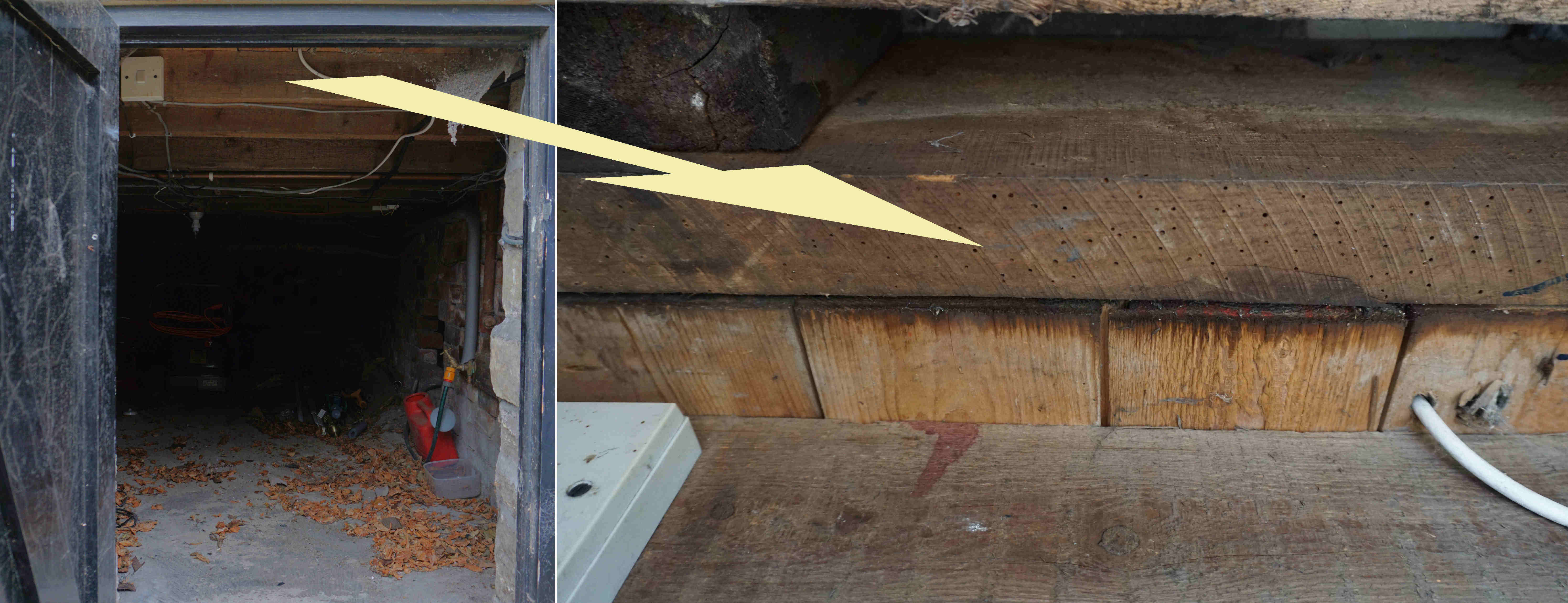
room floor joists were infested with woodworm and could be seen from the
doorway to the cellar, if you just looked up [ Photo ].
The
Surveyor admitted that there was a view, albeit a restricted one: "We
could not gain access to the under floor cellar except limited view from the
door".
But access wasn't needed – just the nouse to look up
and see the woodworm holes.
The
Surveyor blamed a variety of obstacles for his failure to spot the woodworm:
“the area
was full of stored items, in need of cleaning and the light did not work.”
None of this was true.
Damp
We found
damp on a chimney breast – a classic place for damp patches. There was nothing
to obstruct the view, such as a cupboard.
The
Surveyor found one, though: "…I would not expect the inside of the
cupboard to be inspected."
Witness statements
Fay Ellen
Wright, the Judge, said there was no need to repeat our Witness Statements as
she’d already read them.
The
Surveyor’s Statement, filed seconds before the deadline, suggested that he, Mr
Reasonable, was the subject of a client’s vexatious claim, but he was doing his
level best to sort the matter out:
“As an
active Christian I have...been anxious to look compassionately at the case.”
It was
peppered with such words as ‘respected’, ‘professional’, ‘specialist’,
‘expert’, 'recognised, and ‘prominent’.
It was
verbose and very full, but mainly of lies.
As the
Plaintiff, I went first, hoping to give a point-by-point refutation of what the
Surveyor had written.
But the
Judge stopped me from presenting anything that was not already in my
Witness Statement: I couldn’t challenge the Surveyor’s eleventh hour
submissions. Mrs Judge was facilitating
what was, in effect, a Trial by Ambush. In English law this is considered to be
unfair.
Changing
tack, I showed Wright a sketch I’d prepared of the house, thinking it would
help to clarify the layout.
But she
refused to look at it, saying it was new evidence.
Consequently,
at this stage of the proceedings, I was permitted to say almost nothing.
But the
Surveyor had plenty to say, much of it new to the court.
He
claimed, for instance, that I’d only discovered the woodworm during extensive
renovations.
It was not
in his Witness Statement and it was an outright lie, but Judge Wright made no
attempt to be even-handed and stop him saying it.
Questioning
When I was
allowed to question the Surveyor, I asked him how the ‘blocked’ doorway to the
underfloor cellar had stopped him seeing the woodworm.
He
surprised me: “I haven’t said the door was blocked.”
(But he had:
in his Survey Report, he’d named various obstacles that had restricted his view
from the doorway; and in his Witness Statement, he’d claimed he was “unable
to gain access through without considerable moving of objects.”)
But the real issue, it turned out, was not the lack
of access, blockage or restricted view, but the definition of the word “door”:
He went on:
“That’s not the door. It’s the access point.”
Mrs pedantic Judge jumped in sharply, as if to
support him, saying:
“Technically,
what he said was that the access point was blocked. You may ask him whether he
meant the door.”
I said
that the door is an access point.
Mrs Wright
said firmly that “access point” does not mean “door”.
So ended a bizarre exchange that pivoted on the
meaning of a common household fixture.
I next
asked the Surveyor: “Why didn’t you just look up [at the joist]?”
He
replied: “If you’re crouching to go
in and you’re looking round…it’s very restrictive access…I really can’t help
you any more.”
So that was it – he was concentrating on something
else. He was like a driver claiming he
was so busy looking at road signs he really could not be expected to avoid
pedestrians.
For a professional man employed to do a job, it
sounded very much like an admission of negligence [2].
Summing up
If Judge
Wright noticed the Surveyor's admission of failure she did not refer to it in
her summing up.
Instead,
she helped him out with a clever excuse for not spotting the woodworm, one that
Oliver Sacks would have found fascinating [3].
She
declared that using a head torch in an area of restricted height would
have limited his ability to see the wormholes.
She did
not elaborate.
What, I
wondered, was going on?
Why was a
judge inventing evidence that bolstered the case of the defending party?
Well, the
Surveyor had mentioned in his evidence that he'd used torches and had also worn
a hard hat, which sometimes got in his way.
Had Mrs
Judge got confused and mistaken his light for a hat? It seemed so.
Continuing
with her summing up, Wright dealt with the damp issue.
The Surveyor hadn't come up with any credible reasons
for not reporting the damp patch on the chimney breast.
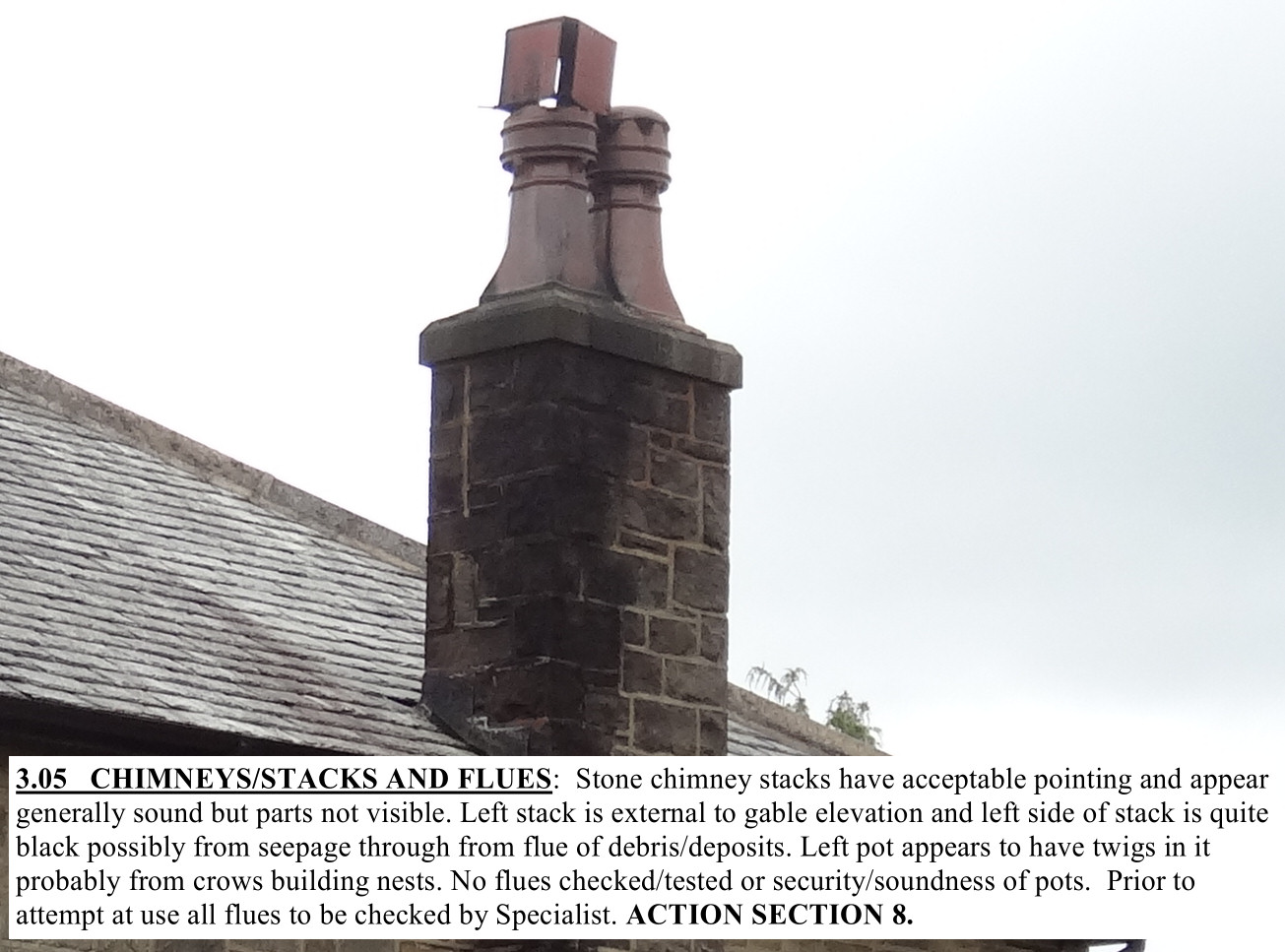
All he'd mentioned in his Survey Report were some “twigs”
on top of the nearby chimney stack [4].
This is his picture of
the chimney pot: he'd confused metal
rods for twigs. An easy mistake to make.
To his
rescue rode the redoubtable Judge.
She
declared that the Surveyor could not be expected to find a damp patch on the
chimney breast because the external inspection had been carried out from the
ground.
But the Surveyor never said how inspected the chimney
(he did say he'd brought a ladder, though not where he'd used it).
So, with
her chimney chicanery, Judge Wright handed the Surveyor a clean sweep.
She moved on to the verdict.
Verdict
After a
hearing lasting an hour and three-quarters, Mrs Wright declared that there was
no departure from the accepted standard of a competent surveyor and dismissed
my suit.
She looked
towards the Surveyor and asked if he wanted to apply for costs.
He could only have asked for his travel expenses and
loss of earnings, the latter being limited to £90 for the day.
However,
he must have remembered that he was an “active Christian”, because he
said he was happy to be magnanimous and did not want to apply for costs.
Appeal?
You can appeal a verdict on the
grounds that the judge has made a procedural error, which would surely include
bias.
It costs about £120.
A copy of the recording of the
trial would be useful – if only to check on the quality of the notes you made.
But the MOJ prefers to skew the process in its favour by keeping recordings to
itself. It will, however, sell you a transcript. This costs north of £300.
I didn’t bother appealing, because
of the cost and because I assumed appeal judges would usually favour their
colleagues.
Footnotes
[1] The
following are comments from 2016, found on the web, made by litigants involved
in parking disputes Wright presided over:
* “she’s a
sour faced dragon.”
* “It is
possible to win this on your own with a fair judge. Clearly judge Wright has
other ideas.”
[2] This excuse by the Surveyor is uncannily
similar to one given by a plumber to a court in Stirling when answering a
charge of negligently installing a gas boiler, causing a house to explode.
Referring
to a failed pipe joint the plumber resorted to the tried and tested restricted
access routine, saying: "It's in a tight space, you've got a boiler in
front of you..", making it difficult to visually inspect the work.
The
tradesman was tried and tested and, in this instance, found guilty of
negligence. (BBC News 22 Dec 2017).
[3] The Man Who Mistook His Wife for a Hat,
Oliver Sacks, 1985.
[4] The metal cowl appears to be fixed to the pot by several spindly rods, which to the untutored eye might look like twigs. The text in the picture is in the Survey Report.
Disclaimer
This blog
is a factual account of what was said at the hearing. Naturally, the
interpretation and selection of those facts is mine.
Words
inside quotation marks are derived from my contemporaneous notes and have been
accurately reported.
I am aware
that losing litigants sometimes accuse judges of bias.
I hope I have shown that this particular judge, Fay
Ellen Wright, blocked parts of my case for breaking her rules, whilst allowing
the other party to break the same rules.
In
addition, she bolstered the other party's case with her off the wall remarks
and imaginary evidence.
I have no
doubt this strange woman was biased. If she wasn't, she must have been having
an extremely bad brain day.
Footnote:
Judge Fay Ellen Wright retired in 2021 at the early age of 62.
.